
1. Introduction
Hook: Most car owners ignore tyre size
Problem: Wrong tyre size affects safety, mileage & comfort
Promise: Simple explanation of car tyre size with real examples
2. What Does Car Tyre Size Mean?
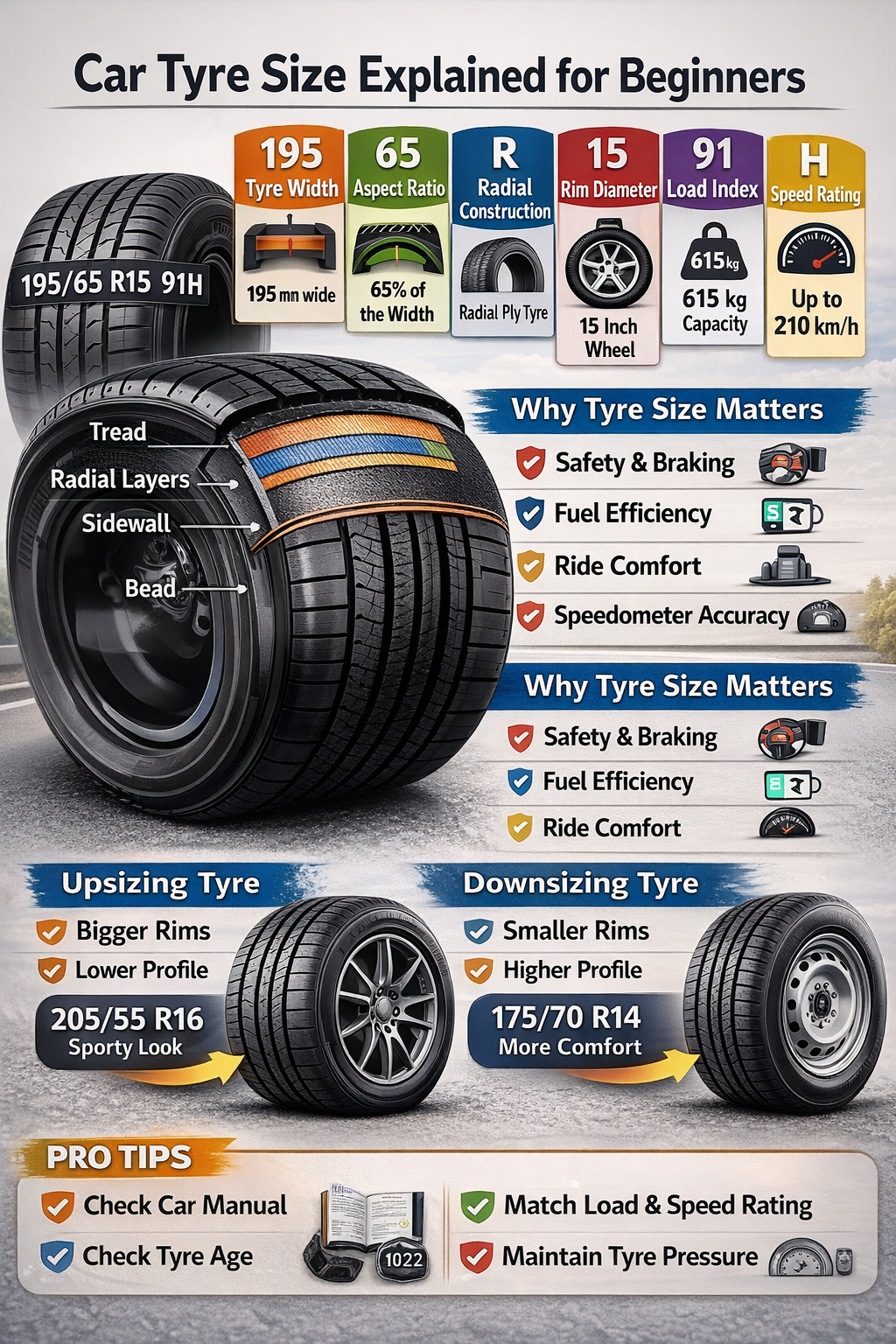
Understanding tyre size format (e.g., 195/65 R15 91H)
Where to find tyre size on your car
3. Breaking Down Tyre Size Numbers
Tyre Width
Aspect Ratio
Radial Construction (R)
Rim Diameter
Load Index
Speed Rating
4. Why Choosing the Right Tyre Size Is Important
Safety
Mileage
Suspension health
Handling & comfort
5. Example: Decoding 195/65 R15 91H
6. Can You Change Tyre Size? (Upsizing & Downsizing Explained)
Pros & Cons
Comparison table
7. Common Mistakes to Avoid
8. Pro Tips Before Buying Tyres
9. FAQs
10. Conclusion with Action Steps
Car Tyre Size Explained for Beginners
If you have ever looked at your car tyre and seen numbers like 195/65 R15 91H, you may have wondered what they mean.
Most car owners in India focus only on the tyre brand. However, ignoring the correct car tyre size can affect your safety, fuel efficiency, and driving comfort.
In this beginner-friendly guide, you will learn:
What tyre size numbers mean
How to read them correctly
Whether you should change your tyre size
And how to choose the right tyre confidently
Let’s break it down step by step.
What Does Car Tyre Size Mean?
Car tyre size is a combination of numbers and letters printed on the tyre sidewall. It tells you:
The width of the tyre
The height of the sidewall
The type of construction
The rim size
The load capacity
The maximum safe speed
You can find the recommended tyre size:
On the tyre sidewall
Inside the driver-side door panel
In your car’s owner manual
Breaking Down a Tyre Size (Example: 195/65 R15 91H)
Let’s decode this popular tyre size commonly used in cars like Maruti Suzuki Baleno, Hyundai i20, and Honda City.
1️⃣ 195 – Tyre Width
This number shows the width of the tyre in millimeters.
195 means the tyre is 195 mm wide
Wider tyres provide better grip
But may slightly reduce mileage
2️⃣ 65 – Aspect Ratio
This is the height of the tyre’s sidewall.
65 means the height is 65% of 195 mm
Higher ratio = More comfort
Lower ratio = Sportier look & better cornering
3️⃣ R – Radial Construction
“R” stands for Radial tyre.
Almost all modern passenger vehicles use radial tyres because:
Better road grip
Improved durability
Longer life
4️⃣ 15 – Rim Diameter
This number tells you the rim size in inches.
R15 means the tyre fits a 15-inch alloy or steel rim
You cannot fit R15 tyres on R14 rims.
5️⃣ 91 – Load Index
This indicates how much weight the tyre can carry.
For example:
91 = 615 kg load capacity per tyre
Always match or exceed your manufacturer’s recommendation.
6️⃣ H – Speed Rating
This shows the maximum safe speed.
H = Up to 210 km/h
Common speed ratings in India include:
T (190 km/h)
H (210 km/h)
V (240 km/h)
Why Choosing the Correct Car Tyre Size Matters
Many beginners think tyre size does not matter much. That’s not true.
Here’s why:
✅ Safety
Wrong size affects braking and stability.
✅ Fuel Efficiency
Wider tyres increase rolling resistance.
✅ Suspension Health
Incorrect profile can damage suspension over time.
✅ Speedometer Accuracy
Wrong tyre diameter gives incorrect speed readings.
Can You Change Tyre Size? (Upsizing vs Downsizing)
Yes, but carefully.
What is Upsizing?
Upsizing means:
Increasing rim size
Reducing tyre profile
Example: 195/65 R15 → 205/55 R16
What is Downsizing?
Reducing rim size
Increasing tyre sidewall
Comparison Table: Stock vs Upsized Tyres
Feature
Stock Tyre
Upsized Tyre
Comfort
High
Slightly lower
Road Grip
Good
Better
Mileage
Better
Slightly lower
Looks
Normal
Sporty
Cost
Affordable
Expensive
Common Mistakes Beginners Make
❌ Choosing wider tyres just for looks
❌ Ignoring load index
❌ Mixing different tyre sizes
❌ Not checking manufacturing date
❌ Buying cheapest tyre without checking brand reliability
Pro Tips Before Buying Tyres
✔ Always follow manufacturer-recommended tyre size
✔ Replace all four tyres together if possible
✔ Check tyre manufacturing date (avoid tyres older than 6 months)
✔ Maintain correct tyre pressure
✔ Rotate tyres every 8,000–10,000 km
Related Keywords (Naturally Covered)
tyre size meaning
tyre sidewall markings
tyre load index
tyre speed rating
upsizing tyres
radial tyres
Frequently Asked Questions (FAQ)
1. Can I use 205 instead of 195 tyre?
Yes, but only if overall diameter remains similar and rim width supports it. Always consult a tyre expert.
2. Does wider tyre reduce mileage?
Yes, slightly. Wider tyres increase rolling resistance.
3. What happens if I use wrong tyre size?
It can affect braking, speedometer accuracy, and suspension life.
4. Is upsizing safe?
Yes, if done within recommended tolerance (usually ±3% overall diameter).
5. How long do car tyres last in India?
Typically 40,000–60,000 km or 4–5 years, depending on usage and road conditions.
Final Thoughts: What Should You Do Now?
Now that you understand car tyre size explained for beginners, follow these steps:
Check your current tyre size.
Read your car manual for recommended size.
Avoid unnecessary upsizing.
Choose a trusted brand.
Maintain proper tyre pressure.
Your tyres are the only contact between your car and the road. Choosing the correct tyre size is not just about performance — it’s about safety.
Make an informed decision and drive confidently. 🚗


